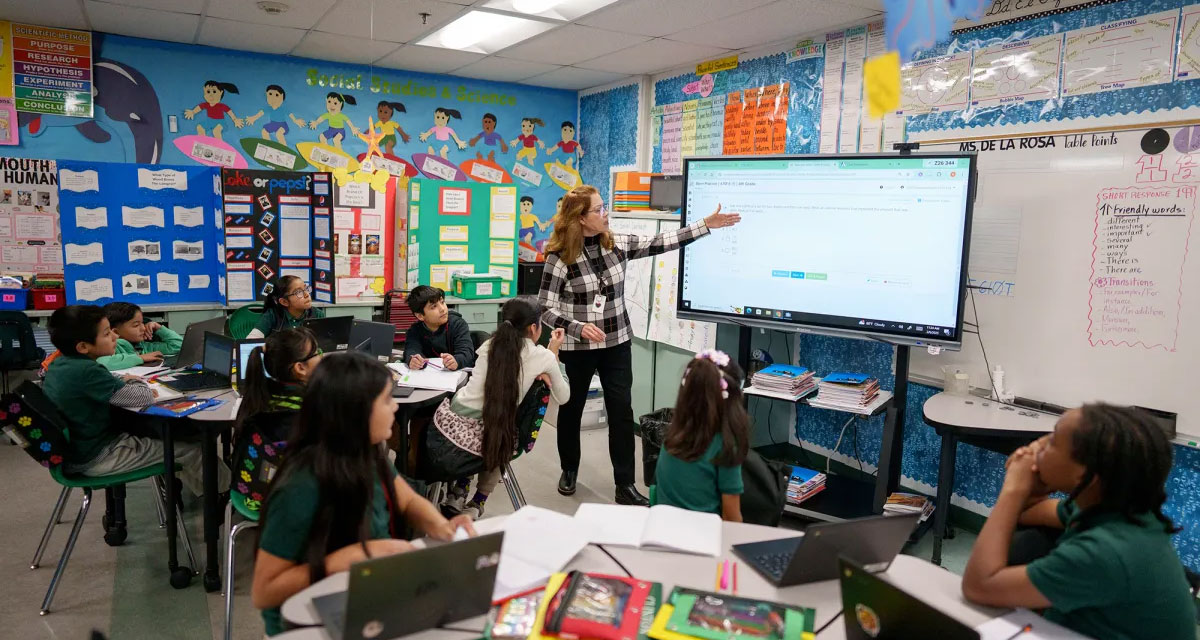


California’s classrooms are stratified by prior achievement, language background, and academic readiness. Most students spend the majority of their instructional time in whole-class settings designed for a broad middle range of performance. As within-class variation grows, the constraints of uniform instructional models become more salient. This report examines how relationship-based individualized instruction, and high-impact tutoring in particular, functions as a structured response to that variation. National data indicate that this approach is already widely adopted: in June 2025, 42% of public school principals reported that their school offers high-impact tutoring, with prevalence remaining between 37% and 46% over the prior three years (NCES, 2025).
High-impact tutoring has one of the strongest causal evidence bases among contemporary K–12 interventions. Meta-analyses of experimental studies find pooled effect sizes of 0.36–0.37 standard deviations on academic achievement—equivalent to 3 to 15 months of additional learning gains. The literature identifies specific design features associated with stronger and more replicable impacts: sustained dosage of at least three sessions per week, group sizes of four or fewer students, alignment with core instruction, data-informed practice, and consistent tutor-student relationships. These features distinguish high-impact tutoring from lower-intensity or ad hoc supplemental support.
This report synthesizes this research base alongside original qualitative and descriptive evidence from California. Data sources include interviews with 82 principals and 94 district leaders, survey responses from 27 district and county leaders (hereafter Local Education Agency [LEA] leaders) participating in a tutoring design sprint, and three district case studies. These data allow examination of how relationship-based individualized instruction is structured in practice, the degree to which implementation aligns with research-supported design features, and the conditions under which programs are sustained.
The analysis is organized around three questions:
- What does causal research show about the effects of relationship-based individualized instruction on student learning and engagement?
- How are California districts currently structuring tutoring and related supports within existing policy, funding, and instructional frameworks?
- What do research findings and implementation evidence suggest about the institutional conditions associated with expanded and consistent access?
The report proceeds in seven sections. The initial sections examine the instructional and equity implications of whole-class delivery models. Subsequent sections synthesize evidence on high-impact tutoring and examine the mechanisms through which program design influences outcomes. The report then analyzes the current policy and funding landscape in California and documents district-level implementation patterns. The final section considers governance and implementation trade-offs associated with moving from fragmented provision toward more systematic access. Throughout, the analysis distinguishes between evidence of program effects and evidence regarding feasibility, design constraints, and scale.
California has directed billions of dollars toward tutoring, intervention blocks, and tiered academic supports, including $7.9 billion through the Learning Recovery Emergency Block Grant, $4 billion through the Expanded Learning Opportunities Program, and $50 million through the Learning Acceleration System Grant. These investments indicate policy prioritization of additional instructional intensity for students who are not meeting grade-level expectations. At the same time, variation across districts in scheduling, staffing models, dosage, and alignment with core instruction indicates uneven incorporation of research-supported design features. The interaction between funding structures, accountability systems, organizational capacity, and local implementation decisions shapes the extent to which high-impact tutoring conditions are realized in practice. Understanding that interaction is central to interpreting the state’s current investment landscape.
The evidence presented in this report indicates that high-impact tutoring is an effective response to instructional heterogeneity, and that features of California’s governance and funding context are associated with divergence between research-based design and observed implementation. Taken together, these findings point to the importance of institutional conditions in shaping whether effective interventions are delivered with fidelity at scale.