


Among the various educational reforms of the past half-century, few have garnered as much attention as charter schools. Charter schools are publicly funded schools that operate with increased autonomy – often under private operators – which families can choose to send their children to instead of their assigned traditional public school (Tong et al., 2023). Established through state legislation, charter schools are often exempt from many regulations governing traditional public schools, leading to their greater operational and instructional autonomy. Since the first state charter law passed in 1991, 45 states and the District of Columbia have opened charter schools (Jacobs & Veney, 2024). Today, over 3.7 million students attend more than 8,100 charter schools across the United States (National Alliance of Public Charter Schools, n.d.-a).
In 1992, California became the second state to pass a charter law. Since then, charter school enrollment has grown significantly, as shown in Figure 1. By the 2024-25 school year, there were approximately 727,000 students attending nearly 1,300 charter schools in California – more than in any other state. In California, charter school students make up about 12 percent of public school enrollment, compared to the national average of 7 percent (National Center for Education Statistics, 2022). This large representation of charter school students in California can partially be explained by the diverse set of charter school models allowed by the state. In addition to newly created brick-and-mortar charter schools, California permits some traditional public schools to convert to charters and also allows for non-classroom-based (NCB) charter schools, which offer at least 20 percent of instructional time outside of an in-person classroom setting.
Figure 1: California Charter School Enrollment Trends
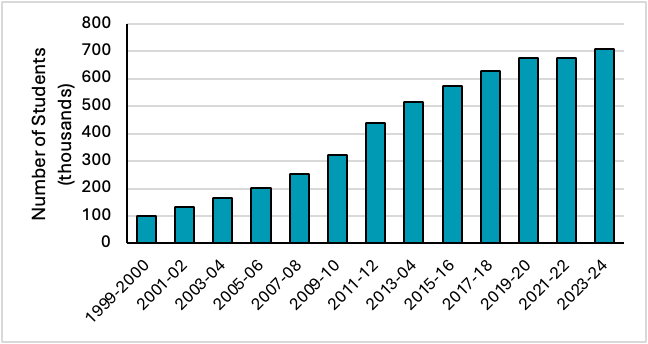
Source: https://edsource.org/2025/california-charter-school-enrollment-fraud-scrutiny-rise/736350
In exchange for autonomy, California charter schools – like those in other states – are held accountable for academic and financial outcomes. Although charter school performance remains the subject of national debate, research in California has found generally positive results. A study comparing charter school students to similar peers in traditional public schools found that California charter students performed comparably in math and outperformed their peers in reading – equivalent to approximately 11 additional days of learning (Raymond et al., 2023). At the same time, California charter schools’ use of public funds has faced recent scrutiny following two high-profile cases of fraud involving approximately $580 million in misappropriated funds (California Charter Authorizing Professionals, 2025). Both cases involved NCB programming, including one school that exclusively provided NCB instruction (Fensterwald, 2024; Pendleton, 2025). As a result, questions about the adequacy of financial accountability for charter schools have emerged, with particular attention to NCB charter schools.
The entities that are responsible for holding charter schools accountable for their academic and financial outcomes are charter school authorizers. Authorizers are government-designated agencies that oversee charter schools’ fixed term contracts. This role is carried out across three key responsibilities: (1) screening proposals for new charter schools, (2) monitoring school performance, and (3) renewing charter contracts or closing charter schools (Vergari, 2001). To the extent that authorizers oversee charter schools well, they can promote increased quality schooling options for families while minimizing poorly managed and low-performing charter schools.
This report examines the current state of charter school accountability and governance in California by focusing on the public entities charged with upholding it – charter school authorizers. Because charter schools are granted autonomy in exchange for accountability, authorizers’ structure and effectiveness play a central role in determining the quality and integrity of the charter school sector. We examine how California’s evolving charter laws and policies have shaped authorizers’ responsibilities, authority, incentives, and capacity over time. Where possible, we address best practices within authorizers’ responsibilities and discuss how policy enables or constrains authorizers’ abilities to adopt them. In this report, we also pay particular attention to NCB charter schools and the role of authorizers in shaping their approval, oversight, and continued operation given the prominence of NCB charter schools in recent public debate and legislative reform efforts.
To conduct this analysis, we first provide context on the entities that currently serve as charter school authorizers in California. Next, we identify the set of California policies that have most directly affected the state of charter school authorizing since 1992. Considering this policy context, we then discuss how California authorizers carry out the roles of authorizing, overseeing, and renewing charter schools. In examining these roles, we draw on multiple sources of evidence that provide insight on authorizers’ practices and current trends, including policy documents, administrative data from the California Department of Education, reports from stakeholder organizations, and findings from peer-reviewed academic research. By triangulating these sources, this report provides a comprehensive assessment of how legislative design has structured authorizing practices – and how those practices in turn have shaped the development and accountability of California’s charter school sector.